|
|
The
Crossbow > Chapter 6
> Shortbow , Longbow and Crossbow
> p.34
The Crossbow
of the statute against crossbows
and hand-guns.' (State Papers, Reign of Henry
VIII.)
In 1542, the last statute against crossbows
and handguns was passed by Parliament. This
one imposed the very heavy fine of 20l. on anyone keeping a crossbow,
and stated among other reasons for the suppression of the weapon ' that
divers murders had been perpetrated by means of crossbows, and that malicious
and evil-minded people carried them ready bent and charged with bolts,
to the great annoyance and risk of passengers on the highways.'
The prohibition of the crossbow
in England was not, it will be understood, the result of a fear that, as
a superior arm, it might usurp the position of the longbow, for when the
first three statutes were passed to suppress it (1508, 1512, 1515) the
crossbow
had been almost supplanted by the hand-gun in Continental armies, and at
the dates of the later Acts, (1537, 1542) it was unknown in warfare. All
the statutes against crossbows and hand-guns
were introduced to prevent the yeomen and peasantry of England from practising
with, or even handling a weapon of any kind other than the cherished longbow,
though the later statutes may have been suggested by a fear that the hand-gun
might cause the people to put less trust in the longbow than formerly,
and thus in some measure to discontinue its use.
The great victories achieved with the English longbow in former days,
induced English kings, and commanders of troops, to believe that no weapon
ever invented or likely to be invented, whether crossbow
or hand-gun, could compete with it. For this reason, the longbow was retained
in English armies beyond the days of its real effectiveness in warfare,
though even then, its decadence was not due to its inferiority to the handguns
of the period, but to a scarcity of archers trained to its proper use.
Even when it was realised (1570-1580)1 that the longbow
was being hopelessly beaten by the hand-gun in battles and sieges
, and had no chance of regaining its position, several statutes were passed,
all of course unavailing, with a view to saving it from extinction as our
national and well-tried weapon.
The longbow was at its best from the time
of Crecy, 1346, to about 1530. It began to decline in favour about 1540.
In the large engraving of the picture of the siege of Boulogne in 1544,
and in the one of the fight between the English and French fleets off Portsmouth
in 1545 (the original pictures were burnt at Cowdray House, in 1793), there
are as many English soldiers depicted with hand-guns and pikes as with
longbows.
In Latimer's sixth sermon, printed in 1549, the Bishop bewails the decline
of the English longbow, and calls upon the magistrates of England to do
their
1 At this time the longbow was, however, quite
as effective as any handgun. Its decadence was due to a neglect to practise
with it during the more or less peaceful reign of Elizabeth. See p. 39,
for Montaigne's criticism of handguns at this period.
The Crossbow
> Chapter 6 >
Shortbow , Longbow and Crossbow
> p.34
|
Save up to 50% with Multi-Plan Deals
|
2 Plans $19.95 FREE Shipping
- Save Over 30%
U.S. Orders Only |
|
Get a Book of Catapult and Trebuchet Plans
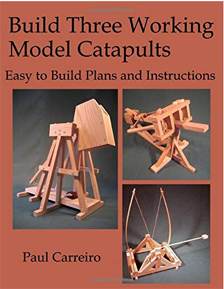
Book of Catapult Plans
On Amazon.com
"Build Three Working Model Catapults, Easy to Build Plans
and Instructions"
|
 Build Three Working Model
Catapults, Easy to Build Plans and Instructions is ideal for anyone
looking to build authentic, working model catapults.
Build Three Working Model
Catapults, Easy to Build Plans and Instructions is ideal for anyone
looking to build authentic, working model catapults.
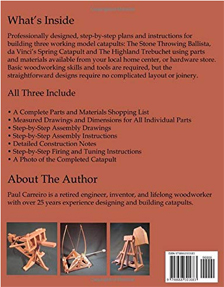
This book contains professionally designed, step-by-step plans and instructions
for building three working model catapults:
The Stone Throwing Ballista, da Vinci's Spring Catapult and The Highland
Trebuchet using parts and materials available from your local home center,
or hardware store.
The straightforward designs require no complicated layout or joinery
and include:
-
A Complete Parts and Materials Shopping List
-
Measured Drawings and Dimensions for All Individual Parts
-
Step-by-Step Assembly Drawings
-
Step-by-Step Assembly Instructions
-
Detailed Construction Notes
-
Step-by-Step Firing and Tuning Instructions
-
A Photo of the Completed Catapult
|
| Working Model Trebuchet Kit |
 |
 Trebuchet
Kit
Trebuchet
Kit
TK1
|
$75.00
FREE Shipping
U.S. Orders Only |

|
|
|
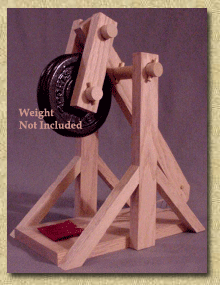
The trebuchet kit includes fully precut and drilled
frame parts, pins and axles, sling cord and sewn pouch, projectiles and
fully illustrated assembly and firing instructions.
Unlike the flimsy, snap together plywood trebuchet
kits, our all hardwood trebuchet kit does not require additional cutting,
trimming or shaping.
Requires only white carpenter's glue and a few
bar clamps (not included) to assemble.
Read
More >> |
Build a Trebuchet From Plans
 |
|
-
Materials Shopping List
-
Complete Parts List
-
Measured Drawings for All Parts
-
Step-By-Step Assembly Drawings
-
Construction Details and Notes
-
How a Trebuchet Works
-
Illustrated Firing Instructions
-
Illustrated Tuning Instructions
-
Picture of the Completed Trebuchet
|
| Fully Assembled Working Models |
|
daVinci
Trebuchet
T4 |
$299.00
FREE Shipping
U.S. Orders Only
|
|
| |
|
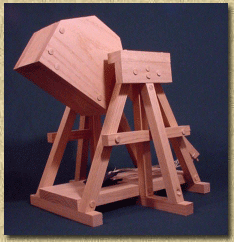
Inspired by the great war machines and siege catapults of Leonardo da Vinci
, this all Red Oak
hardwood trebuchet features
an open counterweight cabinet for range and trajectory adjustment.
Individually crafted from cabinet-grade red oak, the da Vinci Trebuchet
stands 14 inches tall in the cocked position, 24 inches tall in the fired
position and will hurl a projectile up to 60 feet. Includes six projectiles
and fully illustrated instructions.
Read
More >> |
|